2026-11-03 · 8 min read · Scottsdale
What Should a Scottsdale Buyer Check About Soil and Foundations?
What is the direct answer?
Most homes in the Scottsdale area sit on a concrete slab, and most slabs develop some cracking over time. That by itself is not a finding. What matters is the pattern: where the cracks are, which direction they run, how wide they are, whether they are getting worse, and whether anything else in the house agrees with them.
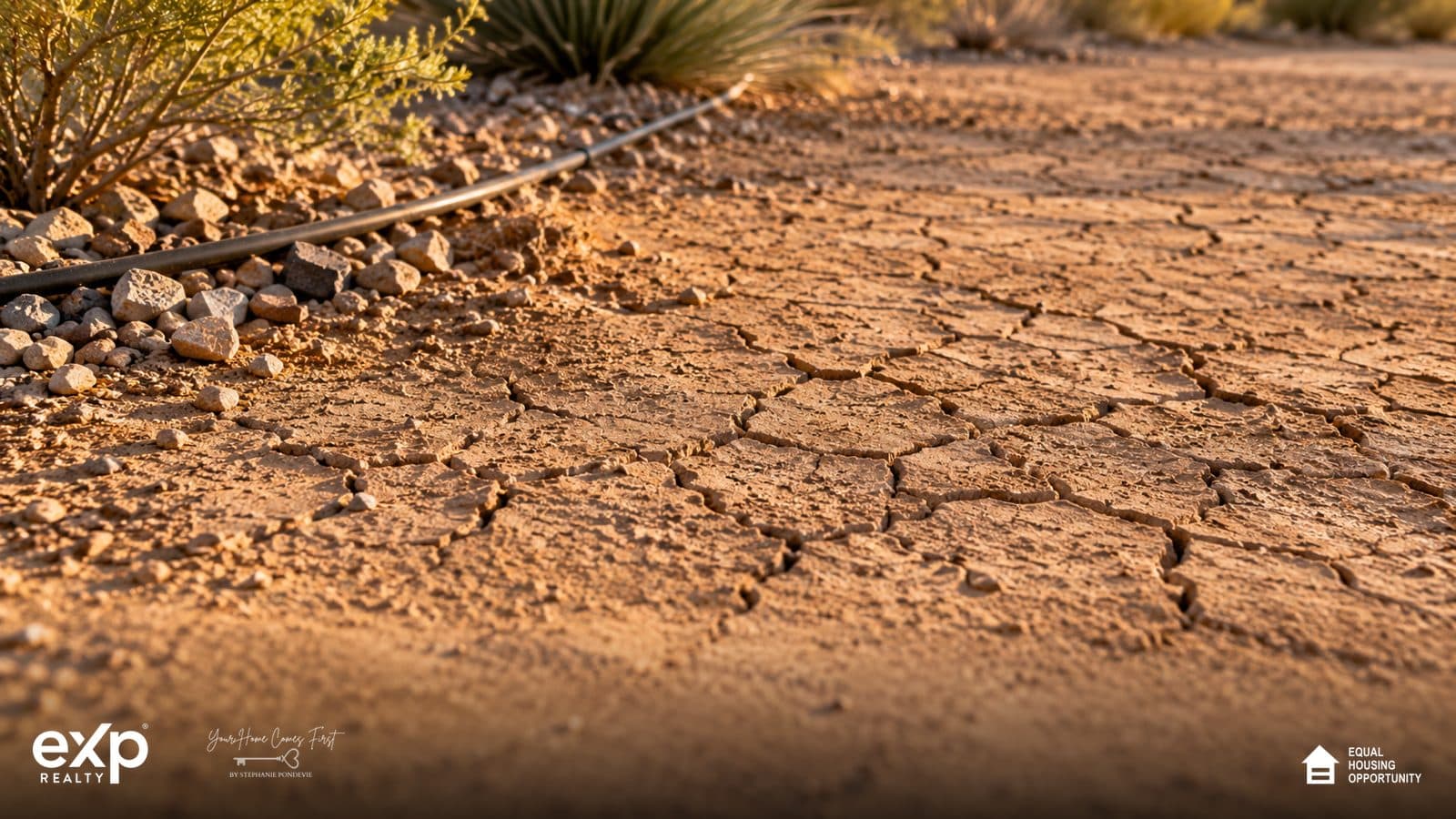
The underlying cause is almost always water, and specifically how water moves around the house. Arizona soils in parts of the Valley can shrink and swell with moisture change, and the soil under a slab moving unevenly is what produces differential settlement. Which means the drainage, the irrigation, and the grading around the home are not a separate topic from the foundation. They are the topic.
You generally have time to investigate this properly. As of September 2026, Scottsdale had 2,238 active listings, 4.02 months of supply, and a median of 69 days to go under contract, according to ARMLS. That is a market where asking for a specialist evaluation during the inspection period is a normal request.
Stephanie Pondevie is a Realtor in Scottsdale, Arizona, helping move-up families sell their current home and buy the next one as one coordinated plan.
Why does soil move at all in the desert?
Because it is not the dryness that causes problems, it is the change.
Some soils in the Phoenix metro area contain clays that expand when they take on moisture and contract when they dry. Repeated cycling, from irrigation, from monsoon storms, from a plumbing leak, from a downspout emptying against the foundation, produces movement. If that movement is uniform under the whole slab, little happens. If one part of the slab is sitting on soil that has moved and another is not, the slab flexes, and concrete does not flex well.
There is a second mechanism worth knowing about in parts of the Valley, which is subsidence and earth fissures associated with long-term groundwater withdrawal. The Arizona Geological Survey maps known earth fissure locations, and that mapping is publicly available. This affects specific areas rather than being a general condition, but it is worth checking rather than assuming.
The practical conclusion for a buyer is the same in both cases. Look at the water, and look at the pattern.
What should you actually look at on a showing?
You can do a useful first pass yourself before paying anyone.
Inside, look at the doors and windows. Doors that will not latch, that stick at one corner, or that swing open on their own. Windows that bind. These are the most sensitive indicators in the house, because a frame racks before a wall shows it.
Look at where walls meet ceilings and where walls meet floors. Separation, gaps, or cracks running diagonally from the corner of a door or window opening.
Look at the floors. Tile cracked in a line across a room rather than a single cracked tile. Grout lines opened up. A floor that feels sloped when you walk it.
Look for drywall cracks that run diagonally, rather than the straight hairlines at a seam that are usually just drying and settling.
Outside, look at the stem wall and any exposed slab edge. Horizontal hairline cracking in stucco is common and usually cosmetic. A crack you can fit a coin into, a crack that steps vertically, or a crack with displacement on either side is different.
Look at the block walls in the yard. They sit on their own footings and they often show soil movement before the house does.
Look at the grading. Does the ground slope away from the house, as it should, or toward it? Is the soil built up against the stucco, above the slab edge?
Look at the drainage. Where do the scuppers and downspouts discharge? Into a landscaped bed against the foundation, or away from the house?
Look at the irrigation. Drip lines running along the base of the stucco, a leaking valve, a thirsty lawn right against the house.
Look at the pool, if there is one. Deck cracking, separation between the deck and the coping, or a visibly out-of-level waterline.
When should you pay for more than the general inspection?
Your general home inspector will note what they see and will tell you when something is beyond their scope. Escalate when any of these are true.
The pattern is consistent. Sticking doors plus a diagonal drywall crack plus cracked tile in a line is a pattern. Any one of those alone usually is not.
There is displacement. One side of a crack sits higher or further out than the other.
There is evidence of a repair. Patched cracks, fresh paint on one wall, a section of new tile, or visible piers or helical anchors around the perimeter. A prior repair is not automatically bad, and it is a reason to find out exactly what was done and whether it carries a warranty.
The home is on a hillside or a cut-and-fill lot, which is common in parts of Scottsdale and introduces its own considerations.
The general inspector recommends it. Take that recommendation seriously rather than treating it as boilerplate.
In those cases, a licensed structural engineer, not a foundation repair company, is who you want. The distinction matters. An engineer is paid to evaluate and tells you what they find. A repair company is paid to repair.
What should you ask the seller and the records?
Ask about prior foundation work, in writing. Arizona sellers complete a Seller Property Disclosure Statement, and foundation repairs, settling, and drainage issues are the kind of thing it asks about. Read those answers and follow up.
Ask for any engineering report or repair documentation, and whether any warranty exists and transfers.
Pull the permit history, since significant foundation work may have been permitted.
Ask about plumbing leaks, because a slab leak is a common source of localized soil moisture.
Ask about insurance claims. Movement-related claims are often excluded, but a past water claim tells you something.
Check the Arizona Geological Survey's earth fissure mapping for the area.
Ask your insurance agent what your policy would and would not cover. Standard homeowners policies commonly exclude earth movement and settling, which is a reason to investigate before you own it rather than afterward.
How do you handle a finding during the inspection period?
Match the response to the severity. A drainage and grading problem is often inexpensive to correct and is the actual root cause. Correcting the drainage is frequently the right ask, not a structural repair.
Get the engineer's opinion before negotiating. Negotiating against an unknown number is how buyers end up both overpaying and underprotected.
Ask for documentation, not assurances, on any repair the seller agrees to.
Know that this affects your resale. Whatever you accept now, you disclose when you sell, and the next buyer's inspector will look at the same walls.
Be willing to walk on genuine structural movement. Drainage is fixable. Significant differential settlement on an active soil condition may not be worth the price, and there will be other houses in a market with 2,238 active listings.
Confirm the mechanics with your agent, since what you can ask for and by when depends on your contract's inspection terms.
What would you actually tell a buyer about this?
Here is what I'd do if this were my house. I would walk the perimeter before I walked the inside, because the drainage and the grading tell you what the soil has been doing. Ground built up against the stucco and a downspout emptying into a flowerbed by the foundation is a story, and the inside of the house is the ending.
Then I would open and close every door in the house. It takes four minutes and it is the most sensitive test available to someone who is not an engineer.
And if the pattern was there, I would hire an engineer rather than a foundation company, and I would do it early in the inspection period so I had time to act on what they said.
Let's run your real numbers, not a guess. Drainage correction and structural repair are different orders of magnitude, and knowing which one you are looking at is the whole question.
What mistakes do Scottsdale buyers make here?
Treating any slab crack as a serious problem, when minor cracking is common and usually cosmetic.
Treating all of them as cosmetic, and never looking for the pattern.
Never checking the grading and drainage, which is the cause rather than the symptom.
Hiring a foundation repair company for an evaluation instead of a licensed structural engineer.
Ordering the specialist late in the inspection period, with no time left to negotiate or walk.
Negotiating a credit before knowing what the repair actually involves.
Not asking whether prior foundation work exists, or whether its warranty transfers.
Assuming homeowners insurance would cover movement, when earth movement and settling are commonly excluded.
The bottom line
Slab cracking is common in Arizona and the question is always the pattern, not the presence. Walk the perimeter for grading and drainage first, because water is the cause. Then check the doors, the tile, the wall and ceiling joints, and the yard walls for a consistent story. If the pattern is there, hire a licensed structural engineer early in your inspection period.
With Scottsdale at 2,238 active listings, 4.02 months of supply, and a 69-day median time to contract as of September 2026, there is both time to investigate and no need to accept a serious structural unknown. Find out which problem you have before you negotiate on it.
Frequently asked questions
Are cracks in a slab foundation normal in Arizona?
Minor cracking is common and often cosmetic. What distinguishes a concern is the pattern: diagonal cracks from door and window corners, displacement where one side sits higher than the other, cracked tile running in a line, doors that no longer latch, and sloping floors. Several of those together is a reason for a specialist.
Should I hire a structural engineer or a foundation company?
A licensed structural engineer. An engineer is paid to evaluate and report what they find. A foundation repair company is paid to perform repairs, which is a different incentive. Get the engineer's opinion first, then decide.
Does homeowners insurance cover foundation problems?
Standard policies commonly exclude earth movement and settling, though a sudden covered event such as a burst pipe may be treated differently. Confirm with your own insurance agent, and treat the pre-purchase investigation as your protection rather than assuming coverage exists.